Definitions
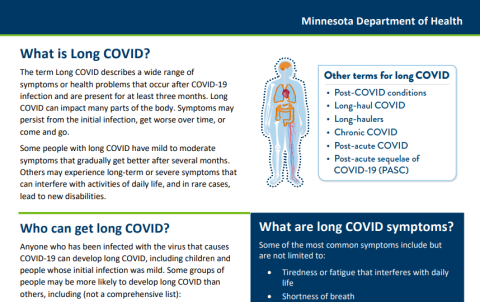
The CDC and the National Academies of Sciences, Engineering, and Medicine describe long COVID as “an infection-associated chronic condition that can occur after SARS-CoV-2 infection, the virus that causes COVID-19, and is present for at least 3 months as a continuous, relapsing and remitting, or progressive disease state that affects one or more organ systems..” However, there is not yet widespread consensus around standard clinical case definitions for most post-COVID conditions. This is in part because studies of post-COVID conditions and long COVID have varied widely by symptoms investigated, temporal criteria, study settings (inpatient vs. outpatient), and data sources (self-reporting versus electronic health records).
The World Health Organization (WHO) has also published a version for consideration (WHO: A Clinical Case Definition of Post COVID-19 Condition by a Delphi Consensus, 6 October 2021), which varies somewhat from the CDC description: "Post COVID-19 condition occurs in individuals with a history of probable or confirmed SARS CoV-2 infection, usually 3 months from the onset of COVID-19 with symptoms and that last for at least 2 months and cannot be explained by an alternative diagnosis. Common symptoms include fatigue, shortness of breath, and cognitive dysfunction among others, and generally have an impact on everyday functioning. Symptoms may be new onset following initial recovery from an acute COVID-19 episode or persist from the initial illness. Symptoms may also fluctuate or relapse over time."
We may include standard clinical and case definitions here as they become available.
More from MDH